

BUILD AND MARKET YOUR SHOPIFY STORE
We help e-commerce brands maximise growth opportunities


The Biggest Shopify Subscription Mistakes Brands Make (And How to Avoid Them in 2026)
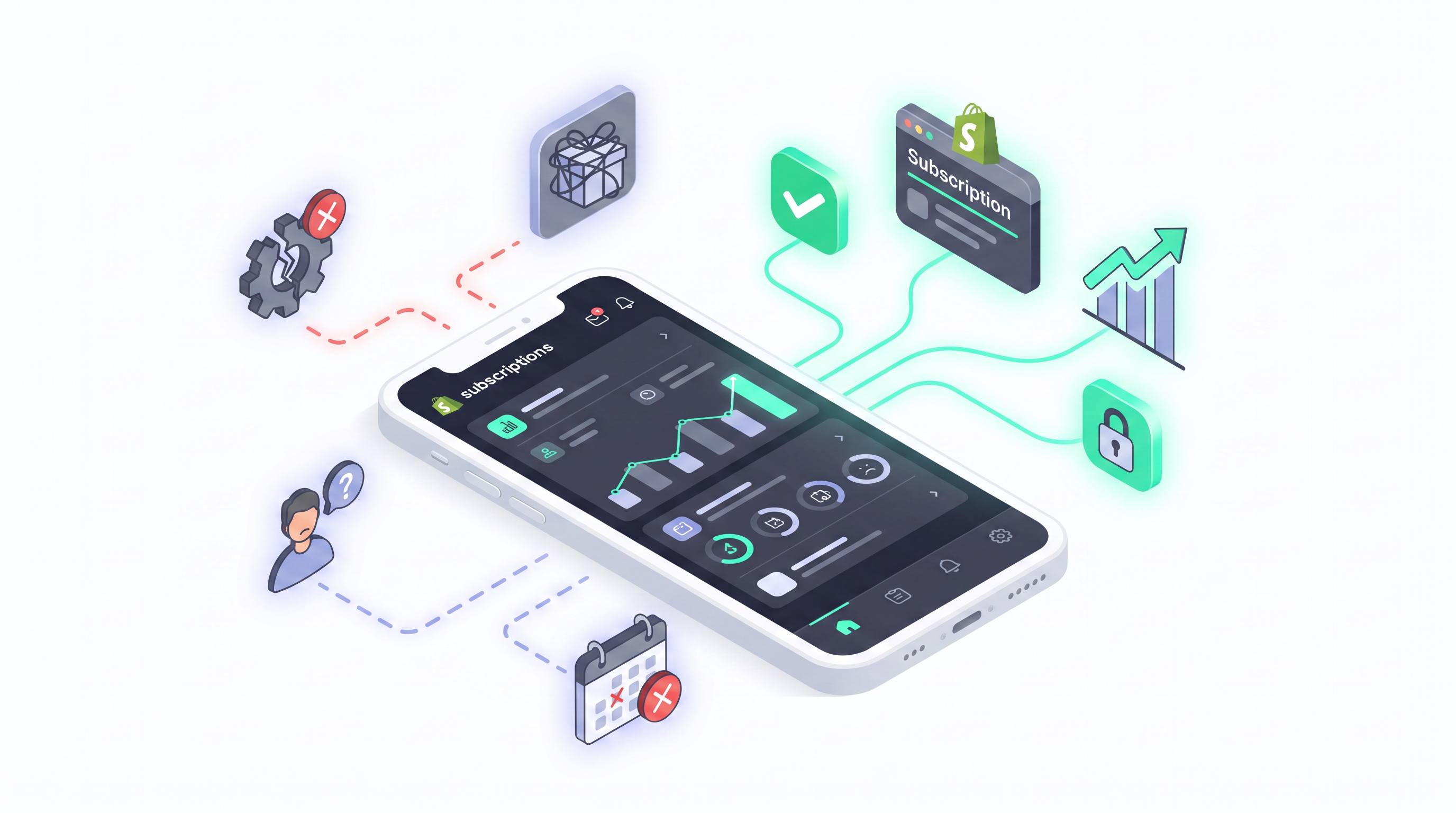

Most Shopify subscription programmes fail because merchants focus on launching subscriptions rather than building an experience customers genuinely want to remain part of. The biggest Shopify subscription mistakes include choosing unsuitable products, relying too heavily on discounts, neglecting subscriber retention, underusing subscription technology, and failing to optimise the customer journey. The brands that build sustainable recurring revenue continually reduce churn, improve customer lifetime value, and refine every stage of the subscriber experience.
According to Recurly's 2026 State of Subscriptions report, which analysed data from 76 million unique subscribers across 2,200 global merchants, 52% of consumers cancelled at least one subscription in the past year. The primary reasons were not price, they were poor customer experience, lack of flexibility, and weak communication. Every mistake in this guide traces back to one of those three root causes.
If you are still deciding whether subscriptions are right for your store or need a full implementation walkthrough, read our complete guide on how to add subscriptions to your Shopify store first.
Key Takeaways
- Most subscription programmes fail because of strategy, not technology
- Only products customers naturally replenish should be offered on subscription
- Large discounts often attract customers who are more likely to cancel
- Retention is usually more profitable than acquisition
- Klaviyo automation and a well-configured subscriber portal significantly reduce churn
- Successful subscription programmes are continually optimised rather than left to run themselves
Why Most Shopify Subscription Programmes Underperform
When subscription growth slows, many Shopify merchants assume the software is the problem. Should they move from Shopify Subscriptions to Recharge? Would another subscription app reduce churn? Is there another platform with better features? These are reasonable questions. However, after helping Shopify merchants launch, migrate, and optimise subscription programmes, we have found that the software is rarely the biggest issue.
Instead, subscription success depends on whether every stage of the customer journey has been designed around convenience, flexibility, and long-term customer relationships. Most underperforming subscription programmes share the same characteristics: products that customers do not naturally replenish, product pages that fail to communicate the value of subscribing, poor onboarding after the first order, little understanding of why subscribers cancel, weak lifecycle email marketing, subscriber portals that customers rarely use, and no ongoing optimisation. Modern subscription platforms provide excellent technology. What separates successful brands is how effectively they use it.
Why Matters perspective: one of the biggest surprises during subscription audits is how much time merchants spend comparing subscription apps. They compare pricing, transaction fees, and feature lists. Yet they rarely ask the questions that actually matter: does this product genuinely suit subscriptions? Why would customers subscribe instead of purchasing once? What happens after the customer's first recurring order? How easy is it to skip, pause, or swap products? Why are subscribers cancelling? These questions almost always have a much greater impact on recurring revenue than choosing between platforms. For more on selecting and setting up the right platform, see our guide to [the best Shopify subscription apps]().
The Why Matters Subscription Success Loop
Over the years we have found that successful subscription brands consistently optimise every stage of the subscriber journey. We call this the Why Matters Subscription Success Loop.
| Stage | Primary Objective | Common Mistake |
|---|---|---|
| Product Selection | Choose products customers naturally replenish | Launching subscriptions on unsuitable products |
| Product Page | Build trust and maximise subscription uptake | Weak messaging, poor social proof, and low subscription visibility |
| First Order Experience | Build confidence immediately after purchase | Little communication after checkout |
| Subscriber Portal | Give customers flexibility and control | Making it easier to cancel than to stay subscribed |
| Email Lifecycle | Increase retention and reduce churn | Poorly configured Klaviyo automation |
| Retention | Increase customer lifetime value | Prioritising acquisition over retention |
| Continuous Optimisation | Improve subscription performance every month | Treating subscriptions as a completed project |
Every mistake discussed throughout this guide interrupts one or more stages of this loop. The strongest subscription brands continually improve every stage rather than assuming the programme will optimise itself.
Mistake 1: Launching Subscriptions on the Wrong Products
One of the biggest Shopify subscription mistakes is assuming every product should be available as a subscription. Customers do not think that way. Subscriptions work best when they remove the need to remember to reorder products people already buy repeatedly. Examples include coffee, vitamins, supplements, skincare, pet food, and household essentials. These products naturally lend themselves to recurring purchasing. Seasonal purchases, gifts, luxury products, and infrequent purchases usually do not.
Simply adding a subscription option because competitors offer one rarely creates sustainable recurring revenue. Before enabling subscriptions, ask yourself three questions: does the customer naturally replenish this product? Does automatic delivery genuinely make life easier? Would customers notice if they forgot to reorder? If the answer to these questions is no, a subscription model may not be appropriate.
Why Matters perspective: one mistake we regularly encounter is merchants attempting to offer subscriptions across their entire catalogue. In reality, many successful subscription businesses generate the majority of their recurring revenue from a relatively small number of products. Identifying those products before launch often produces significantly higher retention than making every product subscribable.
Mistake 2: Using Discounts Instead of Creating Value
Offering subscribers a discount is perfectly reasonable. Building your entire subscription strategy around discounts is not. Many merchants assume larger discounts automatically increase subscriber numbers. Initially, they often do. Unfortunately, they also tend to attract customers who are motivated primarily by price, and those customers are far more likely to cancel when another retailer offers a better deal.
Long-term subscribers stay because the overall experience is valuable, convenient, and flexible. The strongest subscription programmes offer benefits that extend well beyond saving money, including flexible delivery schedules, easy product swaps, early access to new products, exclusive subscriber-only offers, loyalty rewards, priority customer support, and self-service subscription management.
Why Matters perspective: price might encourage someone to subscribe. Convenience is what keeps them subscribed. The subscription brands that consistently outperform their competitors make life easier for customers at every stage of the journey, not just at checkout.
Mistake 3: Ignoring the Subscriber Experience After Checkout
Many Shopify merchants believe the hardest part is persuading a customer to subscribe. In reality, that is only the beginning. The real work starts after the first order. Subscribers need reassurance that they have made the right decision. Every interaction should reinforce the value of remaining subscribed, through delivering orders on time, communicating proactively, making subscription management effortless, providing flexibility when customers' circumstances change, and continuing to educate customers about the value of your products.
One poor experience can undo months of careful acquisition. Unfortunately, many subscription programmes become almost silent after the first purchase. Customers receive little communication beyond shipping notifications and payment receipts. Over time, the subscription begins to feel transactional rather than valuable. The result is predictable: customers cancel.
Why Matters perspective: one of the first things we review during every subscription audit is what happens after checkout. Many merchants invest thousands of pounds acquiring subscribers but very little retaining them. Retention begins the moment someone clicks the Subscribe button, not when they are thinking about cancelling. Subscribers should regularly receive communication that reassures them they have made the right decision, including tips for getting the most from the product, product education, exclusive subscriber content, upcoming delivery reminders, product recommendations, loyalty rewards, and milestone celebrations. The more value customers receive between deliveries, the less likely they are to question whether they should remain subscribed. For guidance on building these communications, see our Shopify email marketing guide.
Mistake 4: Making Subscription Management Difficult
One of the quickest ways to increase cancellations is making subscription management frustrating. Customers expect flexibility. Life changes. They may have too much product, be going on holiday, want to swap flavours, or need to delay a delivery. If those tasks require contacting customer support, many customers decide it is simply easier to cancel.
According to Recurly's 2026 State of Subscriptions report, merchants offering pause-before-cancel options saw pause usage increase by 337% year-on-year, and three out of four subscribers who paused eventually returned. That data point alone makes a well-configured self-service portal one of the highest-value investments a subscription merchant can make. A good subscriber portal should allow customers to pause subscriptions, skip deliveries, change delivery dates, swap products, update payment methods, change delivery addresses, add one-off products, and reactivate cancelled subscriptions.
Why Matters perspective: one of the biggest missed opportunities we see is merchants failing to take advantage of their subscription platform's customer portal. Many businesses invest in sophisticated subscription software but never customise the subscriber experience. The default portal is left untouched, customers receive little encouragement to use it, and features that could dramatically reduce churn remain hidden. A well-designed subscriber portal does not simply reduce customer support enquiries. It gives customers reasons to remain subscribed instead of cancelling.
Mistake 5: Treating Subscriptions as a Set-and-Forget Revenue Stream
Recurring revenue is predictable. It is not automatic. Many merchants launch subscriptions believing the hard work is finished. The reality is quite different. Successful subscription programmes evolve continuously. Customer behaviour changes, competitors introduce new offers, delivery expectations increase, and subscriber expectations evolve. Brands that fail to adapt gradually experience higher churn and slower growth.
The highest-performing subscription businesses constantly analyse their data, monitoring subscription conversion rate, customer lifetime value, average subscription length, churn rate, failed payment recovery, product swap behaviour, skip frequency, and cancellation reasons. These metrics reveal where improvements can be made. Small improvements across several areas often create significant increases in recurring revenue.
Why Matters perspective: one misconception we frequently hear is that subscriptions create easy recurring revenue. In practice, subscriptions require continuous optimisation. Some of the highest-performing subscription programmes we manage are also the ones that undergo the most regular testing, with product pages evolving, email journeys improving, subscriber portals becoming easier to use, and retention campaigns being refined regularly. The brands that continually optimise their subscription programme almost always outperform those that simply leave everything running after launch.
Mistake 6: Focusing on Acquisition Instead of Retention
Growing your subscriber base is important. Keeping those subscribers is even more important. One of the biggest mistakes Shopify merchants make is measuring success by the number of new subscribers acquired each month while paying little attention to the number quietly leaving. This creates what is often called the leaky bucket problem: marketing attracts new subscribers while churn removes existing ones, and the business continues spending more on acquisition without addressing the underlying causes of cancellation.
According to Recharge's 2026 Subscription Trend Report, the top-performing subscription brands invest as heavily in retention as they do in acquisition, because reducing monthly churn by even a small percentage has a dramatically larger impact on annual recurring revenue than increasing subscriber acquisition by the same proportion. A subscriber who remains with your business for twelve months is significantly more valuable than one who cancels after two.
Rather than focusing exclusively on subscriber growth, merchants should monitor monthly churn rate, average subscriber lifetime, customer lifetime value, reasons for cancellation, failed payment recovery rate, average number of skipped deliveries, and reactivation rate. For the full picture on how retention strategy connects to customer lifetime value, see our guide on how to get Shopify repeat customers.
Why Matters perspective: one of the first questions we ask prospective clients is: do you know the average lifetime value of one of your subscribers? Surprisingly, many businesses do not. Even fewer know exactly when subscribers typically cancel or why. We have also found that many cancellations have little to do with the product itself. Instead, they are often caused by poor customer service, delivery delays, courier problems, confusing communication, payment issues, or lack of flexibility. Merchants often invest heavily in acquiring new subscribers while overlooking the operational issues that are quietly driving existing customers away.
Mistake 7: Choosing a Subscription Platform Based on Price Instead of Customer Experience
Choosing a subscription platform is an important decision. Choosing the cheapest platform is not always the best decision. Many merchants compare subscription apps almost entirely on monthly pricing. While costs matter, they represent only a small part of the overall picture. The better question is: which platform helps us deliver the best subscriber experience?
When evaluating subscription platforms, consider whether the customer portal provides enough flexibility, whether subscribers can easily swap products, whether skipping deliveries is simple, whether the platform integrates properly with [Klaviyo](https://www.klaviyo.com rel="sponsored"), whether it supports advanced lifecycle automation, whether customers can update payment methods themselves, whether it provides meaningful subscription analytics, and whether it will continue to meet your needs as your business grows. The right platform should support your retention strategy rather than simply processing recurring payments.
Why Matters perspective: we have worked with merchants using several different subscription platforms. The software itself is rarely the deciding factor. What matters is how well the platform supports the experience you want your subscribers to have. A platform with stronger retention features often delivers a much greater return than one with a lower monthly fee. When advising clients, we do not start by asking which subscription platform they want. We start by understanding how they want their subscription programme to work. Only then do we recommend the technology. For a detailed comparison of the leading platforms, see our guide to [the best Shopify subscription apps]().
Cosmetics Client Case Study: Reducing Churn by 65% and Increasing Customer Lifetime Value by 72%
One cosmetics client approached us after experiencing disappointing subscription performance. Subscribers were joining, but too many were also leaving. After auditing the entire subscription journey, we discovered several opportunities for improvement. The subscription product pages were not doing enough to encourage recurring purchases. Customer reviews and social proof were not prominent enough. User-generated content was difficult to find. The subscriber portal was not being fully utilised. Most importantly, the previous agency had configured a [Klaviyo](https://www.klaviyo.com rel="sponsored") win-back flow that was not working correctly. Subscribers who should have entered the automation simply never received the emails.
Rather than making one major change, we improved every stage of the subscription experience, including making subscriptions the default purchase option where appropriate, improving product page design, moving customer reviews higher on the page, introducing stronger user-generated content, optimising the Recharge subscriber portal, correcting Klaviyo lifecycle automation, and improving the overall subscriber journey.
The results were significant.
| Metric | Result |
|---|---|
| Subscription churn | Reduced by 65% |
| Customer lifetime value | Increased by 72% |
| Subscription lifetime value | Increased by 49% |
No single change produced these improvements. Instead, they came from continually refining every stage of the subscriber journey. This project perfectly illustrates an important principle: subscription growth rarely comes from finding one silver bullet. It comes from improving dozens of smaller experiences that collectively make remaining subscribed easier, more valuable, and more enjoyable.
How to Audit Your Shopify Subscription Programme
If your subscription programme is not delivering the recurring revenue you expected, do not assume the solution is switching subscription apps. Instead, audit the entire subscriber journey using the questions below.
Product Strategy
- Are only naturally replenishable products available on subscription?
- Is subscribing genuinely more convenient than buying once?
- Are subscription benefits clearly explained on every product page?
- Is the subscription option prominent enough?
- Is the default purchase option encouraging subscriptions where appropriate?
Customer Experience
- Does the product page build enough trust?
- Are reviews displayed prominently?
- Is user-generated content helping customers make decisions?
- Is the value of subscribing communicated clearly?
- Does the onboarding experience reassure new subscribers?
Subscriber Portal
- Can customers easily pause subscriptions?
- Can they skip deliveries?
- Can they swap products?
- Can they update payment methods without contacting support?
- Can they change delivery dates themselves?
Retention
- Do you know your monthly churn rate?
- Do you know your average subscriber lifetime?
- Do you know your customer lifetime value?
- Do you know why subscribers cancel?
- Are failed payments automatically recovered?
Email Marketing
- Does every new subscriber receive a welcome journey?
- Are upcoming deliveries communicated in advance?
- Are payment failures handled automatically?
- Are cancellation-risk subscribers identified?
- Is there an effective win-back sequence?
- Are subscribers regularly reminded of the value they are receiving?
If several of these questions produce uncertain answers, there is almost certainly an opportunity to improve your subscription programme. For guidance on building the email flows that support each of these questions, see our Shopify email marketing optimisation guide, and for making sure those emails reach the inbox, our email spam prevention guide covers every technical deliverability layer.
Why Matters perspective: one of the biggest misconceptions surrounding subscription ecommerce is that reducing churn requires dramatic changes. Our experience suggests the opposite. Most of the biggest improvements come from dozens of relatively small refinements: better product pages, improved onboarding, more effective Klaviyo automation, a stronger subscriber portal, better communication, and greater flexibility. None of these changes are revolutionary on their own. Together, however, they can transform subscription performance. That is why we encourage clients to treat subscriptions as an ongoing optimisation programme rather than a one-time project.
Frequently Asked Questions
What is the biggest Shopify subscription mistake? The most common mistake is focusing entirely on acquiring subscribers while paying too little attention to retaining them. According to Recharge's 2026 Subscription Trend Report, the top-performing subscription brands invest as heavily in retention as acquisition. Many brands invest heavily in advertising but do not fully understand why subscribers cancel. Improving retention often delivers a better return on investment than increasing acquisition spend.
Should every Shopify product be offered as a subscription? No. Subscriptions work best for products customers naturally replenish, such as coffee, supplements, skincare, pet food, and household essentials. Products purchased infrequently or seasonally rarely perform well as subscriptions.
How can I reduce subscription churn? Reducing churn usually involves improving several areas rather than finding one quick fix. These include better customer communication, more flexible subscription management, stronger [Klaviyo](https://www.klaviyo.com rel="sponsored") lifecycle automation, easier product swaps, better onboarding, improved customer service, and understanding why customers cancel. According to Recurly's 2026 State of Subscriptions report, merchants offering pause-before-cancel options saw 3 in 4 pausing subscribers eventually return, making flexibility the single most impactful churn-reduction lever available.
Is Recharge better than Shopify Subscriptions? The answer depends on your business requirements. Both platforms allow merchants to sell subscriptions, but they offer different levels of flexibility, customer experience, and integration. If you are comparing the available options, our guide to the [best Shopify subscription apps]() explains the strengths and limitations of the leading platforms in detail.
How often should I review my subscription programme? Subscription programmes should be reviewed continuously. At a minimum, merchants should monitor key metrics every month including churn rate, customer lifetime value, subscription conversion rate, failed payment recovery, subscriber lifetime, and cancellation reasons. Small, continuous improvements generally produce better long-term results than occasional large redesigns.
Final Thoughts
Building a successful Shopify subscription programme is not about finding the perfect app. It is about creating an experience that customers genuinely want to remain part of. The brands that consistently grow recurring revenue understand that subscriptions are built on relationships rather than transactions. They choose the right products, build trust before the first order, continue adding value after every delivery, make subscription management effortless, and never stop improving.
At Why Matters, we have found that the businesses achieving the greatest subscription growth are rarely doing one thing dramatically differently from everyone else. Instead, they are continually refining dozens of small details across the entire subscriber journey. When those improvements work together, they do not just reduce churn. They create happier customers, stronger loyalty, and significantly higher customer lifetime value.
If you would like an independent review of your current subscription programme, get in touch with Why Matters and we would be happy to audit your Shopify store, identify opportunities to reduce churn, and help you build a subscription experience that delivers sustainable recurring revenue.
Related Articles