

BUILD AND MARKET YOUR SHOPIFY STORE
We help e-commerce brands maximise growth opportunities


What Is Shopify and How Does It Work? A Plain English UK Guide
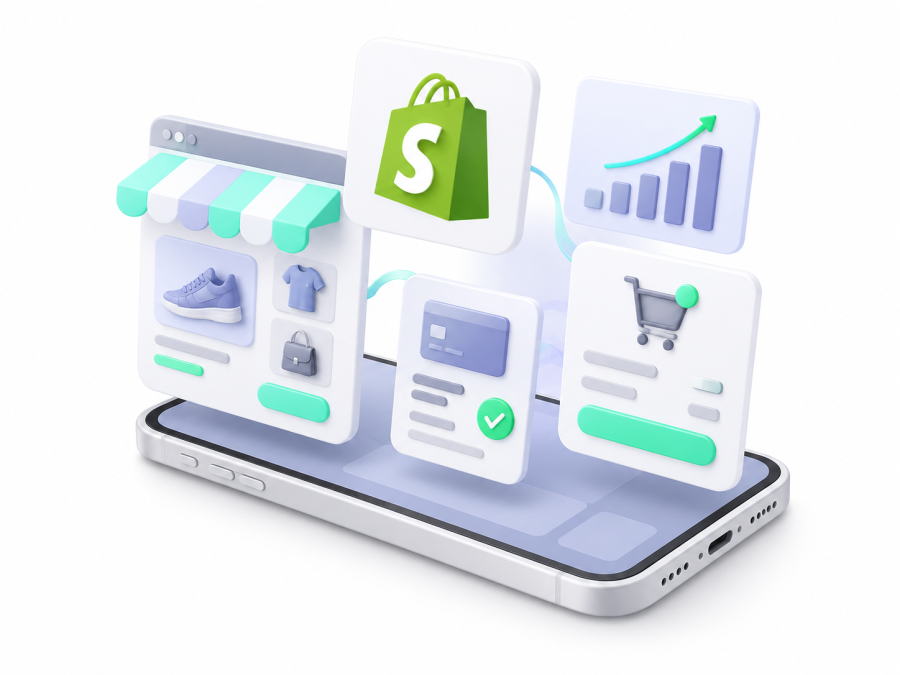
Shopify is software for building and running a shop. You use it to create an ecommerce website, add products, take payments, manage orders, track stock, sell in person and connect your products to other sales channels, and you do not install it on your own server, because Shopify hosts the platform and looks after the underlying hosting, updates and checkout. That makes it very different from WooCommerce, where you usually run your own WordPress hosting, and from Amazon or Etsy, because a Shopify store is your own website: Shopify supplies the technology, not an audience of shoppers.
You still need something people want to buy, good photos, sensible prices, delivery, customer service, marketing, traffic and a margin that works. This guide explains what Shopify actually does, how an order travels from product page to your bank, what it costs in the UK, how long new stores take to make their first sale, its limitations and whether Shopify stores are safe to buy from. Prices and features were checked on 1 October 2026.
Key Takeaways
- Shopify is a hosted commerce platform for selling online, in person, on marketplaces and on other channels, covering hosting, themes, products, stock, checkout, payments, orders, customers and reporting.
- Shopify Basic costs £19 a month billed yearly in the UK, with Grow at £49 and Advanced at £259; apps, paid themes and card fees add to the real cost.
- A £20 UK online card payment on Basic costs 65p through Shopify Payments, 2% plus 25p, leaving £19.35 before your other costs, paid out after at least three business days.
- Shopify does not bring shoppers: stores we launch that invest in marketing usually make their first sale within three days, while owners who market alone typically wait two to four weeks.
- Shopify's platform is Level 1 PCI DSS compliant, but every store is an independent business, so a secure checkout does not make every merchant trustworthy.
- Shopify is not a marketplace like Amazon or Etsy, but it works alongside them: 45% of our clients sell on both Amazon and Shopify.
Quick Answer
Shopify is a subscription commerce platform that lets a business build an online shop, add products, take payments, manage customers and orders, track stock and sell online and in person. A customer visits your store, picks a product, pays through Shopify Checkout and gets a confirmation; you fulfil the order, and the payment provider deducts its fee and pays the rest into your bank. In the UK, Shopify Basic starts at £19 a month billed yearly, and a standard UK online card payment costs 2% plus 25p on that plan. Shopify provides the technology, not the customers, so marketing decides how quickly the sales arrive.
Table of Contents
- What Is Shopify?
- How Does a Shopify Store Work?
- A £20 Shopify Order From Checkout to Payout
- How Much Does Shopify Cost in the UK?
- How Long Until Your First Shopify Sale?
- What Can You Sell With Shopify?
- What Are the Downsides of Shopify?
- Is It Safe to Buy From a Shopify Store?
- Is Shopify Like Amazon or Etsy?
- How Do You Get Started With Shopify?
- Why Matters Perspective
- Frequently Asked Questions
- Final Thoughts
- Related Articles
What Is Shopify?
Shopify describes itself as a commerce platform for selling online and in person, combining hosting, a store builder, themes, products, collections, cart, checkout, payments, stock, orders, customers, discounts, marketing tools, analytics, in person selling and app integrations in one account. Because it is cloud based and hosted, you do not rent a server, install or update the software, patch the server or maintain the checkout; you remain responsible for your products, design, content, policies, customer service, marketing, fulfilment, the apps you install, staff access and how the business runs. Think of Shopify as the operating system of the business, not a company that runs the shop for you.
Your storefront is built from a theme, which controls the homepage, navigation, collections, product pages, colours, fonts and mobile layout; Shopify offers free themes and third party paid ones, and you can make most changes without code, while a developer can build custom sections and integrations. Apps add features Shopify does not include, such as reviews, subscriptions, loyalty, email, quizzes, search, returns, shipping and support, charged monthly, by usage or once, which is useful but can quietly build a large software bill; see our guide to the best Shopify apps. Shopify Payments is the built in payment service, so eligible UK merchants can take cards and wallets without a separate gateway.
How Does a Shopify Store Work?
A Shopify store has two sides: the storefront your customers see, and the Shopify admin you use to run the business. In admin, you add each product with its name, description, price, images, variants, SKU, stock, weight and shipping details, and make it available on your sales channels. Shoppers then arrive from Google, ads, TikTok, email, affiliates or recommendations, because Shopify does not supply visitors, and the product page has to win the sale with images, price, reviews, delivery and returns information and a clear Add to Cart button.
At checkout, Shopify collects contact details, the delivery address, shipping method and payment, with accelerated options such as Shop Pay, Apple Pay and Google Pay where available, and applies any discounts or free shipping rules. Once the payment succeeds, through Shopify Payments or your chosen provider, the order appears in Shopify admin and the customer gets a confirmation email, and from there you can refund, return, cancel or edit orders and review fraud analysis. Shopify does not put the parcel in a van, so you pack it yourself, use your warehouse or a 3PL, then add tracking, which Shopify passes to the customer.
A £20 Shopify Order From Checkout to Payout
Take a UK store on Shopify Basic using Shopify Payments, with a customer paying £20 by an ordinary UK card and no refund or chargeback. The standard UK online card rate on Basic is 2% plus 25p, so the fee is 40p plus 25p, or 65p, leaving £19.35. That is not profit: you still have VAT or other tax, product cost, packaging, delivery, warehouse costs, advertising, returns, apps, your Shopify subscription and staff to pay for, and the example only shows what the payment fee takes.
The £19.35 then moves through Shopify Payments settlement: UK merchants have a minimum settlement period of three business days from capture, the receiving bank usually takes another 24 to 72 hours to show the money, and you can choose daily, weekly or monthly payouts where supported, with a £1 minimum. So the journey is £20 paid, a 65p fee, £19.35 before your other costs, then a payout to your bank; our guide to Shopify Payments in the UK covers payouts, holds and disputes.
How Much Does Shopify Cost in the UK?
For most new UK stores, the headline Shopify plans are:
| Plan | Price billed yearly | UK online card rate |
|---|---|---|
| Basic | £19 a month | 2% plus 25p |
| Grow | £49 a month | 1.7% plus 25p |
| Advanced | £259 a month | 1.5% plus 25p |
Billed monthly, they cost £25, £65 and £344, and Shopify Plus, for more complex businesses, starts from £1,800 a month on a three year term. The plan is not the whole cost, because card processing, paid apps and themes, custom development, domains, email or SMS usage, shipping labels, POS Pro and other services all add up, depending on the business; see our Shopify pricing UK guide for the full picture.
If you use another payment provider, Shopify adds its own third party transaction fee on relevant transactions, 2% on Basic, 1% on Grow, 0.6% on Advanced and 0.2% on Plus, on top of that provider's charges. PayPal and manual payments are excluded when Shopify Payments is active, but always model the payment setup you actually plan to use.
How Long Until Your First Shopify Sale?
This is the question most new sellers really want answered, and the honest answer is that it depends far more on marketing than on Shopify. Clients we launch on Shopify who invest in marketing from day one, such as Google Shopping, paid social or email to an existing audience, usually make their first sale within three days. When we check in with clients who chose to market the store themselves, their first sale has typically taken between two and four weeks.
The platform is identical in both cases; the difference is whether people are sent to the store. A new store receives almost no meaningful visitors unless the business creates them through SEO, Google Shopping, Google Ads, Meta, TikTok, email, creators, affiliates, PR, partnerships, marketplaces or offline activity, so budget for marketing as part of launch rather than after it.
What Can You Sell With Shopify?
Shopify covers much more than simple physical ecommerce: physical products, digital products with the right apps, subscriptions, wholesale and B2B, retail shops and pop ups, and international selling. What you can legally sell still depends on Shopify's policies, your payment provider's rules, UK law and the laws where your customers are, because Shopify provides the technology but does not take on your legal responsibilities.
What Are the Downsides of Shopify?
Shopify solves many technical problems, but it comes with compromises. Apps add up: five £30 a month apps cost £150 a month, or £1,800 a year, before your plan, which is fine if an app earns its keep but wasteful if nobody remembers installing it. External payment gateways can attract Shopify's extra transaction fee, 2% on Basic, which makes them noticeably dearer than Shopify Payments.
Checkout customisation is limited below Plus. Standard plans can brand checkout with your logo, colours and fonts, and apps can extend the thank you and order status pages, but apps that change the information, shipping and payment steps are Plus only, as are most advanced Checkout Blocks; that managed checkout is part of why Shopify stays so secure and easy to upgrade. Above all, Shopify does not create demand or run the business for you: it cannot choose what you sell, set your margin, make the product good, decide how much stock to buy or answer customer emails.
Is It Safe to Buy From a Shopify Store?
The platform is well protected: Shopify is Level 1 PCI DSS compliant, the card security standard, with a current attestation running from 26 June 2026 to 26 June 2027 and quarterly external scans; every store gets a TLS certificate, so connections use HTTPS; Shopify manages the checkout; and Shopify Payments adds fraud analysis and 3D Secure where applicable. But when you buy from a Shopify store, you are buying from that independent business, and Shopify says merchants are responsible for their products, policies, practices and orders, so a secure platform does not mean a trustworthy merchant.
The padlock only means the connection is encrypted; it does not prove the products are genuine, the order will arrive, the returns policy is fair or the reviews are real. Before buying, look for a clear business name and contact details, which Shopify requires merchants to publish, delivery and returns policies, independent reviews, realistic prices, established social accounts, a sensible domain and recognised payment methods. If a site selling £800 products gives no real contact details and the price looks too good to be true, using Shopify should not override those warning signs.
Is Shopify Like Amazon or Etsy?
No, and this is one of the most common misunderstandings:
| Point | Shopify | Amazon or Etsy |
|---|---|---|
| What it is | Technology for your own store | A marketplace you sell inside |
| Shoppers | You bring them | Already there |
| Brand and customer | Yours to control | Within the marketplace's rules |
| Fees | Plan, payments and apps | Listing, referral and other fees |
A Shopify store is like opening your own shop, where you choose the name, design, range and prices and attract the customers, with Shopify supplying the storefront, checkout, products, orders and payments. Amazon gives you demand but less control of fees, listings and the customer, and Etsy brings its own audience for products that meet its Creativity Standards. The choice need not be either or: 45% of our clients sell on both Amazon and Shopify, using marketplaces for discovery and Shopify as the brand's home; see our Amazon vs Shopify and Etsy vs Shopify guides.
How Do You Get Started With Shopify?
Shopify offers a short free trial, with promotional pricing for new accounts when we checked, and you can build before you launch. The steps are:
- Start an account and begin building before launch.
- Add products with names, descriptions, prices, images, variants, SKUs, weights and stock, favouring quality over quantity.
- Choose a theme, starting free until you know what you need; a paid theme makes sense when it replaces several apps or custom work.
- Organise the catalogue with collections, navigation, filters and search built around how customers shop.
- Set up payments, usually Shopify Payments, checking card rates, PayPal, wallets, buy now pay later and international needs.
- Set up delivery: zones, prices, free delivery threshold, dispatch times, carriers and international shipping that make commercial sense.
- Add your domain, connecting an existing one or buying a new one; your myshopify.com address stays behind the scenes.
- Add legal and service pages: contact details, privacy, terms, delivery, returns and refunds.
- Test the whole journey on mobile and desktop, from product page and variants to checkout, confirmation, fulfilment and refund.
- Launch and market it, because publishing is the start, not the finish line.
Our step by step guide to setting up a Shopify store covers each stage in more detail.
Why Matters Perspective
Why Matters is a Shopify agency, so we spend far more time on Shopify than on other platforms, but we do not recommend it because it can do everything; it cannot. We recommend it for how much ecommerce infrastructure a growing business avoids owning, with Shopify looking after hosting, updates, the core checkout, payments and security while the merchant concentrates on products, merchandising, conversion, marketing and retention. That suits product led businesses that do not want to maintain servers and core software.
We would not recommend Shopify just because someone wants an ecommerce website: a tiny service business selling three digital products might prefer a simpler site builder, and a business with very unusual technical needs, or one deeply invested elsewhere, may have no reason to move. The useful question is what problem Shopify would solve, and the answer should be more than everyone else uses it. And whatever platform you choose, launch with a marketing plan, because that, not the software, is what turns three days into four weeks. Our Shopify retainers start from £650 a month plus VAT, and our Shopify packages cover development, design and marketing; see Why Shopify for why we specialise in the platform.
Frequently Asked Questions
What exactly does Shopify do?
Shopify provides the technology to build and run an ecommerce business: storefront, hosting, products, checkout, orders, stock, customer records, payments and sales channel connections. You still supply the products, fulfilment, customer service and marketing.
How does Shopify work for beginners?
You open an account, choose a theme, add products, connect a domain, set up payments and delivery, then publish. When someone buys, Shopify records the order and payment, and you fulfil and manage it from Shopify admin.
How much does Shopify take from a £20 sale?
On Shopify Basic with a standard UK online card through Shopify Payments, the fee is 2% plus 25p, so 65p on £20, leaving £19.35 before product, delivery, tax, marketing and other costs.
How long does it take to get your first sale on Shopify?
It depends on marketing. Clients who launch with us and invest in marketing usually make their first sale within three days; those who market the store themselves typically take two to four weeks.
Is it safe to buy from a Shopify store?
Shopify provides encrypted connections, a Level 1 PCI DSS compliant payment environment and fraud tools, but each store is run by an independent business, so check its contact details, delivery and returns terms and reviews.
Is Shopify like Amazon?
No. Amazon is a marketplace with its own shoppers, while Shopify is the technology for running your own store. You must bring your own traffic, but you control the brand and customer relationship, and many brands use both.
Can you make money on Shopify?
Yes, but Shopify does not guarantee sales or profit. Profit depends on demand, pricing, margin, marketing cost, conversion, fulfilment, returns and repeat purchases, so the business model still has to work.
Final Thoughts
Shopify is easier to understand once you stop thinking of it as a website builder: it is the system underneath the ecommerce business, handling the website, products, stock, checkout, payments, orders, customers, in person selling and integrations while Shopify maintains the platform. For a new UK business, Basic starts at £19 a month billed yearly, a £20 card order costs 65p in fees, and the real cost then depends on payments, apps, theme, development, marketing and fulfilment.
Those numbers only explain the software. Shopify cannot tell you whether people want the product, whether you can reach them affordably, whether the margin works or whether they will buy again, which is why the same platform can power a store that sells in three days or one that waits a month. If Shopify looks right for you, start with our Why Shopify guide, then see our Shopify packages if you want help building, improving or marketing the store.
Related Articles
- How to Set Up a Shopify Store: A Step by Step Agency Guide
- Shopify Pricing UK: Plans, Fees and What You Will Really Pay
- Shopify Payments UK: Fees, Payouts and How It Works
- Shopify Alternatives: The Best Ecommerce Platforms for UK Businesses
- Amazon vs Shopify: Should You Sell on Amazon, Shopify or Both?
- Etsy vs Shopify: Should You Sell on Etsy, Shopify or Both?
- Shopify Statistics UK: Store Numbers, Market Share and Growth
- How Much Does It Cost to Build a Shopify Store? A Transparent Guide

Ayo is the founder of Why Matters and Head of Marketing. With over 20 years of experience in ecommerce, digital marketing and commercial growth, he has helped hundreds of Shopify brands build, launch and scale their online stores. Why Matters, a Shopify agency based in Brighton, is a Shopify Select partner and a Klaviyo, Recharge, Awin, Meta and TikTok partner.About AyoConnect on LinkedIn
Talk to our team
Tell us a little about your store and we'll get back to you within 24 hours.