

BUILD AND MARKET YOUR SHOPIFY STORE
We help e-commerce brands maximise growth opportunities


What Is Klaviyo? A Plain English Guide for Shopify Stores
Key Takeaways
- Klaviyo is a marketing platform for online brands that combines customer data with email, SMS and other messaging.
- It describes itself as a B2C CRM and reported more than 205,000 customers and revenue up 26% year on year in its second quarter of 2026.
- Its Shopify integration syncs customers, orders, products and browsing, which powers automated flows and segments.
- Flows are automatic messages triggered by what a customer does; campaigns are one off sends you schedule.
- The free plan covers up to 250 active profiles with 500 email sends a month and 150 SMS credits; paid plans are priced by active profiles.
- Across our Klaviyo clients, the welcome series and abandoned cart and checkout flows are normally the best performing flows.
Quick Answer
Klaviyo is an email and SMS marketing platform, which it now calls a B2C CRM, used by online brands to collect subscribers, send automated and scheduled messages, and personalise them with store data. For a Shopify store, it connects to your customers, orders and products, then sends flows such as welcome series, abandoned cart reminders and post purchase emails, plus campaigns such as newsletters and sales. It has a free plan for up to 250 active profiles, and paid plans rise with the number of active profiles.
Table of Contents
- What Is Klaviyo?
- How Klaviyo Works With Shopify
- What Klaviyo Does: The Main Features
- Flows and Campaigns Explained
- How Much Klaviyo Costs
- What Is Klaviyo CDP?
- Who Klaviyo Is For
- The First Five Things to Build in Klaviyo
- Why Matters Perspective
- Frequently Asked Questions
- Final Thoughts
- Related Articles
If you run a Shopify store, you have probably heard Klaviyo recommended more than once. This guide explains what it is, what it does and how it works with Shopify, in plain English. We are a Klaviyo partner, so we say where it is not the right choice too.
What Is Klaviyo?
Klaviyo is a marketing platform built around customer data. It records who your customers are and what they do, such as the products they view, the baskets they leave and the orders they place, and uses that data to send the right message at the right time by email, SMS and other channels.
Klaviyo now describes itself as an autonomous B2C CRM. In its results for the quarter to 30 June 2026, it reported revenue of $370.6 million, 26% higher than a year earlier, and more than 205,000 customers. The same release names newer products such as Composer, Customer Agent and K:Social, which bring AI into planning messages and answering customers.
How Klaviyo Works With Shopify
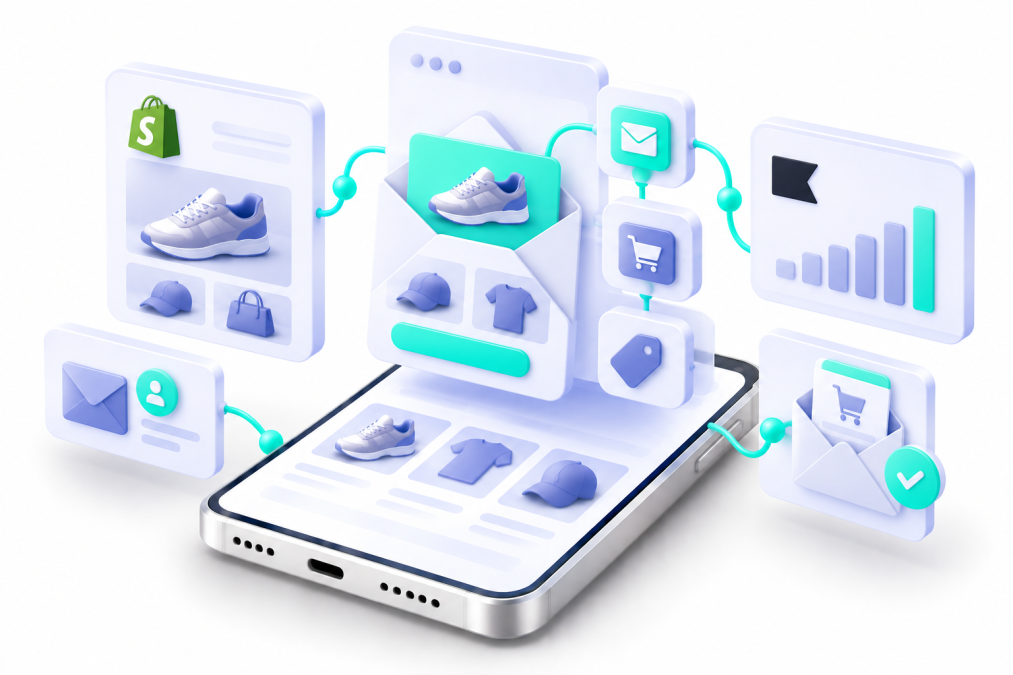
Klaviyo connects to Shopify through an integration installed from the Shopify App Store. Once connected, it syncs your customers, orders and products, and tracks on site activity such as product views and added to cart events. That data does three jobs:
- Triggers flows, such as an abandoned cart email when someone leaves a basket.
- Personalises messages, for example by showing the products someone viewed or recommending items that go with their last order.
- Builds segments, such as customers who have bought twice, spent over £100 or have not ordered for 90 days.
This depth of store data is the main reason brands move to Klaviyo. When five of our clients moved from Mailchimp to Klaviyo, the feature they valued most was building complex flows from the large range of triggers available through integrations with their store and apps.
What Klaviyo Does: The Main Features
| Feature | What it does | Why it matters |
|---|---|---|
| Sign up forms | Pop ups and embedded forms to collect email and SMS subscribers | Grows the list you can market to |
| Flows | Automated messages triggered by customer behaviour | Earns revenue around the clock |
| Campaigns | Scheduled sends to lists or segments | Newsletters, launches and sales |
| Segments | Groups built from behaviour, purchases and profile data | The right message to the right people |
| SMS and WhatsApp | Text messages and, with setup, WhatsApp messages | Fast, direct channels for opted in customers |
| Reporting | Revenue and performance by flow, campaign and segment | Shows what is working |
| Reviews | Collects and displays product reviews | Social proof tied to customer data |
Klaviyo's help centre explains WhatsApp campaigns and flows for accounts that have connected WhatsApp and collected consent; our guide to WhatsApp marketing covers the costs and rules.
Flows and Campaigns Explained
In words: a flow starts automatically when one customer does something, such as signing up, leaving a basket or placing an order, and sends messages to that person. A campaign is a message you plan and schedule, such as a newsletter or a sale, sent to a whole list or segment at once.
Flows usually earn the most for the least ongoing effort. Across our Klaviyo clients, the welcome series and abandoned cart and checkout flows are normally the best performing flows by total revenue and conversion rate. Our guide to Klaviyo flows for subscription brands and email marketing campaigns go into detail.
How Much Klaviyo Costs
Klaviyo's pricing page lists a free plan for up to 250 active profiles, which allows 500 email sends a month and includes 150 SMS credits. Paid plans are priced by the number of active profiles, with separate options for email and for email plus mobile messaging. For current UK prices, see our Klaviyo pricing UK guide.
Because you pay for active profiles, list hygiene saves real money. Some of our clients pay over £800 a month for Klaviyo alone, and removing 5,000 unengaged profiles from a 45,000 profile list cut one client's bill to £600 a month with no drop in email revenue.
What Is Klaviyo CDP?
Klaviyo CDP is Klaviyo's customer data platform, which Klaviyo now calls the Klaviyo Data Platform, or KDP. Every account includes the standard version, and the extra tools most people mean by Klaviyo CDP come in a paid add on, Advanced KDP. Klaviyo's Help Center defines a customer data platform as a system that collects and unifies data from multiple sources and makes it available to other analytics, marketing and advertising tools.
Standard KDP covers profiles, segments, integrations and data storage, and every Klaviyo Marketing plan includes predicted customer lifetime value. Advanced KDP adds no code data cleaning, custom objects for things like subscriptions, merging of duplicate profiles, syncing with data warehouses such as Snowflake and BigQuery, and reports including RFM analysis, cohorts and a customisable lifetime value prediction. It suits brands with several data sources or an analyst; as a Klaviyo partner, we would still tell most Shopify stores to use the standard tools fully first.
Advanced KDP is a separate subscription, priced on the total number of profiles stored in your account, whatever their marketing status, rather than the active profiles your main plan counts, which our Klaviyo pricing guide explains. So suppressing unengaged profiles trims the main bill but not this one, and Klaviyo advises suppressing rather than deleting once you have it. The pricing page slider shows current prices, and Klaviyo offers customers a 30 day free trial through its sales team.
Who Klaviyo Is For
- A good fit: growing Shopify stores where email and SMS earn a meaningful share of revenue, subscription brands, and stores with several customer types or product ranges.
- Perhaps not yet: very new stores with small lists, which may start with Shopify Email or a cheaper platform and move later.
If cost is the main concern, our Omnisend review and Mailchimp alternatives guide compare other options.
The First Five Things to Build in Klaviyo
- Authenticate your sending domain so emails reach the inbox; see stopping emails landing in spam.
- Add sign up forms with a clear reason to join; see getting more email subscribers.
- Build the welcome series. Of the last 50 startup stores we took on, 37 had no welcome flow live.
- Build abandoned checkout, abandoned cart and browse abandonment flows.
- Build a post purchase flow that helps customers use the product and asks for a review.
Then plan a regular campaign calendar and a winback flow. Across 198 of our client stores, email is a median 30% of revenue once these are in place.
Why Matters Perspective
We are a Klaviyo partner, so we have an interest to declare, and most of the Shopify stores we look after use Klaviyo. We recommend it because its store data and flow triggers let a small team run marketing that feels personal at scale. We are just as clear that the platform does nothing on its own: the results come from the flows, the list quality and the campaigns built on it.
We run Klaviyo audits, flow optimisation, deliverability fixes, segmentation and campaign planning. We are a Shopify Select partner, our pricing is published, and retainer clients are billed one month in arrears with no long contracts. For a free Klaviyo account review, visit our email marketing agency page.
Frequently Asked Questions
What is Klaviyo?
Klaviyo is a marketing platform for online brands that combines customer data with email, SMS and other messaging. It connects to stores such as Shopify, records what each customer does, and uses that data to send automated and scheduled messages. Klaviyo describes itself as a B2C CRM and reported more than 205,000 customers in its second quarter of 2026.
What is Klaviyo used for?
Online stores mainly use Klaviyo for email and SMS marketing: sign up forms, welcome series, abandoned cart and checkout reminders, post purchase messages, newsletters and promotions, all personalised with store data. It is also used for segmentation, reporting, product reviews and, increasingly, WhatsApp and AI assisted marketing.
Is Klaviyo free?
Klaviyo has a free plan for up to 250 active profiles, which allows 500 email sends a month and includes 150 SMS credits. Paid plans are priced by the number of active profiles, so the cost rises as your list grows.
How does Klaviyo work with Shopify?
Klaviyo connects to Shopify through an integration that syncs customers, orders, products and browsing activity. That data powers flows such as abandoned cart and post purchase emails, product recommendations in emails, and segments built from what customers have bought and how much they have spent.
What is the difference between Klaviyo flows and campaigns?
Flows are automated messages sent to one person when they do something, such as signing up, leaving a basket or placing an order. Campaigns are one off messages you schedule to a list or segment, such as a newsletter or a sale announcement. Most stores need both.
Is Klaviyo better than Shopify Email?
Shopify Email is simpler and built into Shopify, which suits stores just starting out. Klaviyo offers deeper segmentation, more ways to trigger automated flows and richer reporting, which matters as a list and its email revenue grow. In our experience, many stores start with Shopify Email and move to Klaviyo later.
Is Klaviyo worth the cost?
For most growing Shopify stores, yes, because email and SMS usually earn far more than the platform costs. Across 198 of our client stores, email is a median 30% of revenue. Keep the cost in check by removing unengaged profiles, since Klaviyo charges by active profiles.
Final Thoughts
Klaviyo is the email and SMS platform most growing Shopify stores end up using, because it turns store data into messages that sell. Understanding flows, campaigns and how pricing works is enough to get started.
Build the welcome and abandoned cart flows first, keep your list clean, and add campaigns and other channels once the basics earn their keep. If you would like help, email us.
Related Articles

Written by the Why Matters team. Why Matters is a Shopify agency in Brighton and a Shopify Select partner with Verified Skills across development and marketing, and a Klaviyo, Recharge, Awin, Meta and TikTok partner. We design, build and grow Shopify stores for UK brands, with our prices published and a 3 month guarantee on every development project.About Why Matters
Book a 30 minute call
Pick a time that suits you and the call is booked. No forms to chase, no obligation.
- 1Pick a time. Calls are 30 minutes, Monday to Friday, over video.
- 2Tell us about your store. We ask for your name, email, phone number and what you would like to talk about.
- 3Talk it through. You get our view and next steps, with no obligation and no sales pitch.
Trusted by HOLOS, Dotty Dungarees, Halo Coffee, Gunna, Mama Bamboo and Awake Organics
Shopify Select partner


Shopify Select partnerPrefer email? info@whymatters.co.uk, or call 01273 569264. We only use your details to arrange the call. See our privacy policy.
Choose a time →
Loading the calendar…